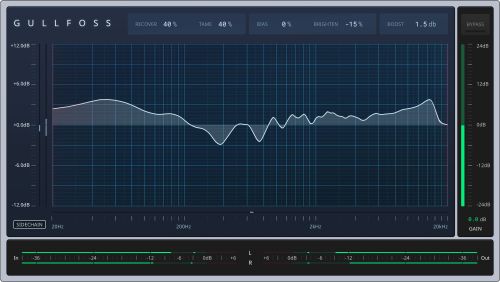
Gullfoss vs FabFilter Pro-Q 3: Intelligent EQ vs Surgical EQ
They are both called equalizers, but Gullfoss and FabFilter Pro-Q 3 work in fundamentally different ways. One listens and decides for you across the whole spectrum hundreds of times a second; the other gives you precise, manual control over every band. Here is how each thinks and when to reach for which.
Gullfoss and FabFilter Pro-Q 3 are two of the most respected EQ plugins on the market, but comparing them is a bit like comparing a self-driving feature to a steering wheel. Pro-Q 3 is a surgical, manual equalizer: you decide every frequency, gain, and bandwidth. Gullfoss is an intelligent, automatic equalizer: it analyzes the sound through a model of human hearing and reshapes the whole frequency response in real time, with just four high-level controls.
Neither is better in the abstract, and plenty of professionals own and use both. Understanding how each one thinks is the key to knowing which to reach for, and to using them together rather than treating them as rivals.
How FabFilter Pro-Q 3 Works: Manual and Surgical
Pro-Q 3 is a classic parametric equalizer taken to its highest refinement. You place up to 24 bands wherever you want, each with a chosen frequency, gain, and Q (bandwidth), and you can run them static, dynamic, or linear-phase, with per-band mid/side processing. The control is total and the decisions are all yours.
That makes Pro-Q 3 the right tool whenever you can name a specific, fixed problem. A harsh resonance at 3.4 kHz, a muddy buildup at 250 Hz, a need to high-pass a guitar at 90 Hz, a surgical notch to kill a hum, a deliberate boost to add air, all of these go in precisely and predictably. The dynamic bands extend that precision to problems that come and go, acting only when a chosen frequency crosses a threshold. The price of all that power is that you have to know what you want and how to dial it in; the plugin does nothing until you tell it to.
How Gullfoss Works: Perceptual and Automatic
Gullfoss does not use bands at all. Instead it runs the incoming audio through a computational model of human auditory perception, continuously works out which parts of the spectrum are being masked or are dominating, then adjusts the entire frequency response to improve clarity and balance, updating those adjustments hundreds of times per second. You never choose a frequency or set a Q.
Control comes down to four macro parameters. Recover boosts spectral content that is being masked, bringing hidden detail forward. Tame attenuates frequencies that are too dominant or are masking other elements. Bias shifts the focus of the analysis toward the low or high end, and Brighten adds high-frequency presence in a perceptually aware way. You set the overall intensity and let the plugin make the thousands of tiny decisions.
This makes Gullfoss extraordinarily fast for a certain class of problem: the dense mix that sounds congested, the master that loses clarity when everything plays at once, the vocal that needs to open up without you hunting for the exact frequency. Because the correction is dynamic and content-aware, it adapts as the arrangement changes, doing more work in a busy chorus than a sparse verse without any automation.
The Core Difference: Bands vs the Whole Curve
The fundamental distinction is what each plugin operates on. Pro-Q 3 works on individual bands that you define, even in dynamic mode, where each band reacts to the energy at its own chosen frequency. Gullfoss works on the entire frequency response at once, with no bands, continuously reshaping the whole curve based on what the ear would want to hear.
This is why a dynamic EQ and Gullfoss are not the same thing, even though both react to the signal. A dynamic EQ compresses or expands a fixed frequency band when the level at that band crosses a threshold; the band is still something you placed. Gullfoss has no fixed bands and instead changes the whole EQ curve many times per second in response to the perceptual content of the audio. One is precise and local, the other is holistic and perceptual.
When to Reach for Which
A simple rule covers most situations: if you can point to a specific frequency and describe a fixed problem, use Pro-Q 3; if the mix sounds good in sparse sections but loses clarity, punch, or separation when everything plays together, reach for Gullfoss.
- Pro-Q 3: surgical notches, high-pass and low-pass filtering, deliberate tonal shaping, de-essing with a dynamic band, mid/side width control, matching the tone of two songs with EQ Match, and any move you want to be exact and repeatable.
- Gullfoss: dense mixes that feel congested, masking that moves around as instruments enter and exit, a master that needs clarity without you knowing exactly where, vocals that should open up perceptually, and fast results when you have no time to hunt for frequencies.
- Both together: a full mix or master where Pro-Q 3 handles the structural decisions (high-pass, a couple of deliberate cuts and boosts) and Gullfoss handles the congestion that emerges, which no single band can fix.
They Work Better Together
The most common professional approach is not to choose between them but to chain them. A typical mix-bus or master chain might place a Pro-Q 3 first to make the structural moves you can name (roll off rumble, cut a known harsh region, add a touch of air), then follow with Gullfoss to resolve the masking and density that emerge when the full arrangement plays together. The manual EQ handles the problems you can describe; the intelligent EQ handles the ones you can only hear as a general loss of clarity.
There is also a cost-of-CPU and a cost-of-attention angle. Pro-Q 3 demands your attention and rewards it with precision; Gullfoss demands almost none and rewards you with speed. On a deadline, Gullfoss can open up a congested mix in seconds. When you have time and a clear diagnosis, Pro-Q 3 lets you fix the exact thing that is wrong. Soundtheory also pairs Gullfoss with Kraftur, a perceptual saturation tool, for engineers who want to add harmonic warmth with the same hands-off philosophy. Owning both an intelligent EQ and a surgical EQ, and knowing which job suits which, is one of the clearest upgrades a mixing setup can make.
Frequently asked questions
Is Gullfoss just a fancy dynamic EQ?
No. A dynamic EQ still uses bands that you place, and each band reacts to the level at its own fixed frequency. Gullfoss has no bands at all. It runs the audio through a model of human hearing and reshapes the entire frequency response hundreds of times per second based on what the ear would find clear and balanced. Both react to the signal, but a dynamic EQ is precise and local while Gullfoss is holistic and perceptual.
If I can only buy one, which should I get?
For most producers, FabFilter Pro-Q 3 is the more essential first purchase because it covers the widest range of EQ tasks: surgical cuts, tonal shaping, filtering, de-essing, mid/side work, and EQ matching, all under your direct control. Gullfoss is a powerful, time-saving addition, but it solves a narrower class of problem (perceptual congestion and masking) that a skilled engineer can also handle manually with Pro-Q 3. Buy the surgical EQ first, add the intelligent EQ when you want speed and a second perspective.
Can I use both on the same channel?
Yes, and it is a common professional approach. A typical order is Pro-Q 3 first to make the structural moves you can name, such as a high-pass and a couple of deliberate cuts, followed by Gullfoss to resolve the masking and density that emerge when the whole arrangement plays. The manual EQ fixes the problems you can describe, and the intelligent EQ handles the general loss of clarity you can only hear.
Does Gullfoss replace the need to learn EQ?
No. Gullfoss is fast and effective, but it solves a specific kind of perceptual problem and gives you only broad control over intensity. Learning manual EQ with a tool like Pro-Q 3 teaches you to identify and fix specific frequencies, a foundational mixing skill you will need on individual tracks, for surgical problems, and any time you need an exact, repeatable result. Gullfoss complements that skill rather than replacing it.