
LASS 3: The Divisi String Library Built for Complex Orchestral Writing
LASS 3 from Audiobro is the first commercially available string library recorded with full section divisi, giving composers independent control over every stand of players. Here is what makes it the go-to choice for Hollywood scoring and intricate voice leading.
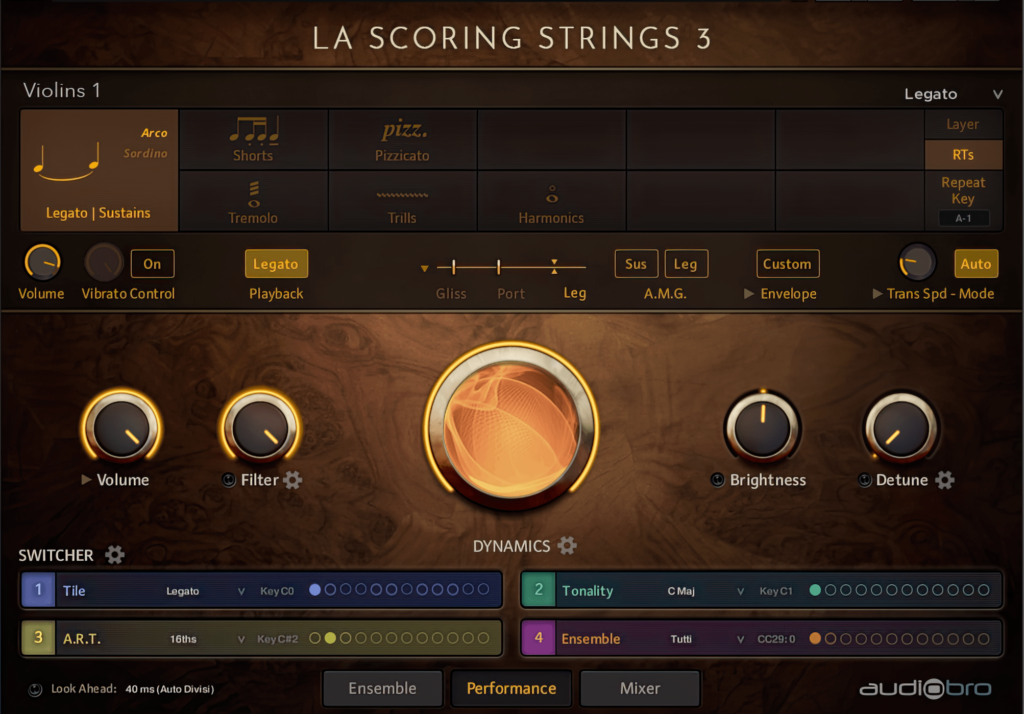
Audiobro LASS 3 (LA Scoring Strings 3) holds a unique position in the world of orchestral libraries: it is the first commercially available string library recorded with full section divisi, meaning each stand of players was captured on its own dedicated microphone feed. Where most string libraries blend an entire section into a single homogeneous sound, LASS 3 lets you address first and second violins, violas, cellos, and basses as truly independent subdivisions. The result is a level of detail and separation that simply does not exist anywhere else at this price point, making it an essential tool for composers who demand precision.
The library was recorded dry at a Hollywood scoring stage, a deliberate choice that gives composers complete control over the acoustic space. Rather than baking in a fixed ambience, LASS 3 is designed to sit inside your own reverb, whether that is an IR of a real scoring stage, a convolution plugin, or a plate. This dry foundation pairs perfectly with the ART (Adaptive Response Technology) articulation system, which reads your MIDI performance in real time and blends sustains, sautilles, spiccatos, and legato transitions dynamically. The combination of dry source material and intelligent articulation switching makes LASS 3 one of the most responsive and controllable string libraries ever produced.
Section Divisi: Why Separate Stands Change Everything
Classical orchestral writing frequently calls for divisi passages, where a single string section splits into two or more independent voice groups playing different pitches simultaneously. In most sample libraries, simulating this requires layering multiple instances and fighting phase coherence issues, because the underlying recordings all come from the same blended section. LASS 3 solves this at the recording level. Each stand group was miked independently, so when you split your violins into four voices across a suspended chord, each part carries its own micro-timing, bow pressure variation, and room response.
This architectural difference matters most in complex polyphonic writing: string quartet textures inside a full section, chromatic voice leading where individual lines cross, contrapuntal passages drawn from Baroque or Renaissance models applied to a modern Hollywood palette. Composers writing for prestige television drama or feature film will find that LASS 3 handles these scenarios without the artificial blend that betrays most virtual string sections. The divisi capability also makes it far easier to create convincing col legno, sul ponticello, and sul tasto contrasts between stands within the same section.
The ART System and Dry Hollywood Sound in Practice
The ART articulation system is what separates LASS 3 from a simple multisampled library. Rather than requiring you to manually switch keyswitches mid-phrase, ART monitors your velocity, note duration, and playing speed, then crossfades between articulation layers in real time. A slow melody at medium velocity flows into a natural long bow sustain; speed up the same passage and the system transitions into sautille without interrupting the phrase. This makes mock-ups feel far closer to a live performance and dramatically reduces the MIDI editing time needed to sell a demo to a director or music supervisor.
The dry recording philosophy means every reverb decision remains yours. Composers working on diverse projects, from intimate chamber cues to massive action sequences, can recondition the same LASS 3 patches to suit radically different acoustic contexts simply by adjusting the reverb send. This is in direct contrast to libraries where a lush hall reverb is baked into every sample, limiting flexibility in a mix. For hybrid orchestral work where live strings will eventually replace some virtual parts, the dry source also aligns more naturally with the acoustic footprint of a real tracking session.
LASS 3 vs CSS: Choosing the Right String Library for Your Project
Spitfire Audio Chamber Strings (CSS) and LASS 3 are frequently compared, and both are exceptional, but they occupy genuinely different creative spaces. CSS uses a smaller chamber ensemble recorded in a warm, intimate acoustic environment. The playing style leans expressive and slightly romantic, with a natural bloom that flatters lyrical melody writing and cinematic emotional arcs. CSS patches feel immediate and musical straight out of the box, which makes it popular with composers who want inspiration to flow without much post-processing.
LASS 3 is a Hollywood workhorse built for technical precision. The full-size scoring stage ensemble, the dry capture, the divisi architecture, and the ART system all serve composers who need to solve specific orchestration problems at a professional level. If your cue requires a string section to execute four independent inner voices across a complex jazz-influenced harmony, LASS 3 is the correct tool. If you need a beautiful, ready-to-place string swell for a trailer or emotional underscore, CSS will get you there faster. Many professional composers own both and route projects to each based on the musical and technical demands of the cue.
Frequently asked questions
Does LASS 3 require a full version of Kontakt?
Yes — LASS 3 requires the full retail version of <strong>Native Instruments Kontakt</strong>, not the free Kontakt Player. A current Kontakt license is needed to load the library and access all ART system functionality. Check the Audiobro website for the minimum supported Kontakt version before purchasing.
Is LASS 3 suitable for composers who are new to orchestral libraries?
LASS 3 rewards composers who already understand orchestral writing and signal chain fundamentals. Because the samples are recorded dry, you will need a quality reverb plugin and some experience dialing in a realistic room to get results that compete with finished film scores. Composers newer to orchestral work may find a library with built-in ambience easier to start with, then graduate to LASS 3 as their technical knowledge grows.
Can LASS 3 be layered with other string libraries in the same project?
Layering works very well precisely because of the dry recording. You can combine LASS 3 sections with a wet library on a different reverb bus to add body and space, or use LASS 3 for inner voice detail while a larger ensemble library handles the main melodic line. The clean source material means phase cancellation between layers is easier to manage than when stacking two wet libraries with differing built-in acoustics.