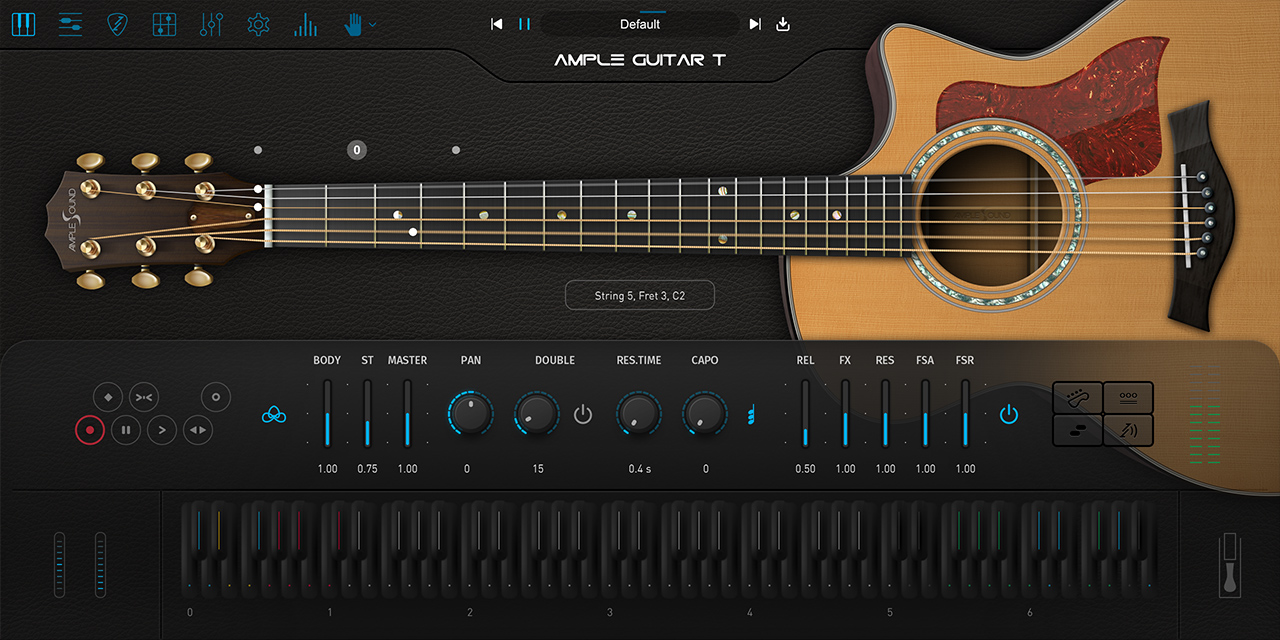
Real vs Virtual Acoustic Guitar: When an Ample Guitar VST Actually Wins
A recorded guitar from a good player usually beats a sampled one. But not always, and not for every producer. Here is an honest look at when a virtual instrument like Ample Guitar T is the better choice, and when you should book a real player.
Ask a room of engineers whether a real acoustic guitar beats a virtual one and most will say yes without blinking. They are usually right. A skilled player with a good instrument, a decent room and a couple of microphones gives you nuance that sampling still struggles to fully capture. But "usually right" is not "always right," and treating the question as settled costs producers time, money and finished tracks.
The honest answer depends on who you are, what you are making and what you actually have on hand. Ample Guitar T, modeled on a Taylor acoustic, is good enough that in plenty of real situations it is the smarter pick, not the compromise. This guide lays out where each option genuinely wins so you can decide per project instead of by reflex.
Where a Real Recorded Guitar Wins
A live performance carries information that is very hard to sample: continuous vibrato that bends and swells across a held note, the exact attack of a pick chosen for that one phrase, the way a player leans into the emotional peak of a line, the unrepeatable interaction between hands, strings and the body of a specific instrument. In an exposed arrangement, especially one already built from real drums, bass and vocals, a programmed guitar is the element most likely to stick out as fake.
Lead playing is the clearest case. Expressive solos with bent and held vibrato notes, microtonal slides and dynamic phrasing are where virtual instruments still give themselves away fastest. If the guitar is the focal point of an indie, folk, blues or singer-songwriter track and you have a competent player on hand, recording the real thing is almost always worth it.
- Exposed solo or lead lines with expressive bends and vibrato.
- Acoustic-driven genres where the guitar is the star: folk, singer-songwriter, unplugged.
- Productions already built from live drums, bass and vocals, where one fake element gives the game away.
- Situations where you have a skilled player, a usable room and time to record and edit.
Where Ample Guitar T Wins
Ample Guitar T wins the moment any of its practical advantages matter more than the last few percent of realism. It is there at 3am with no booking, no mic setup, no room treatment. It is always in tune, never has a bad take, and you can edit it note by note after the fact. You can transpose it, re-voice it or rewrite it in seconds, which is impossible with a printed recording. For a producer without a player, a guitar or a quiet room, it is not a compromise; it is the only realistic way to get a guitar part at all.
It also wins in genres where the source gets processed anyway. In lo-fi, hip-hop, pop, cinematic and ambient productions, the guitar is often bitcrushed, filtered, drowned in reverb, layered under synths or chopped into a loop. That processing erases most of the unrepeatable nuance of a live take, so paying for studio time to capture it makes little sense. A well-programmed Ample Guitar T part sitting under a vocal or fading in beneath a pad is indistinguishable in context.
- Demos, sketches and writing sessions where speed and editability matter most.
- Lo-fi, hip-hop, pop, cinematic and ambient styles where the guitar is heavily processed.
- Rhythm and texture parts: strummed beds, fingerpicked arpeggios, atmospheric chords.
- Producers without access to a player, an instrument or a quiet recording space.
- Parts you may need to transpose, re-voice or rewrite repeatedly.
The Realism Gap Is Smaller Than It Used to Be
The old assumption that virtual guitars are obviously fake is going out of date. Convincing realism needs dozens of round robins, multiple velocity layers and separate captures for every articulation. Ample Guitar T is built exactly that way, with a true sampled Taylor, multiple articulations, a strum engine and Capo Logic that keeps voicings physically playable.
Most of the remaining gap is not in the samples but in the programming. A virtual guitar entered as block chords on a perfect grid will always sound fake. The same instrument played with strum gestures, legato transitions, realistic voicings and humanized timing crosses into territory where casual listeners cannot tell. In practice, "real or virtual" is often really "well-programmed virtual or badly-programmed virtual," and that second variable matters more than people assume.
A Practical Decision Framework
Run each guitar part through these questions before reaching for a microphone or opening a sampler. The answers usually point clearly to the right tool.
- Assess exposure: Is the guitar the focal point of the arrangement, or does it sit in the background as texture or support?
- Assess processing: Will the guitar sit naturally in the mix as recorded, or will it be filtered, drowned in reverb, layered, or chopped into a loop?
- Assess access: Do you have a skilled player, a well-tuned instrument, and a quiet recording space available right now?
- Assess finality: Is this the final master, or a demo that may change significantly before release?
- Decide: If the guitar is exposed, expressive, and you have access — record the real thing. If it is supporting, processed, or access is limited — use Ample Guitar T and invest the saved time in programming it well.
Frequently asked questions
Can listeners tell the difference between Ample Guitar and a real acoustic?
It depends on the part and the programming. An exposed, expressive solo with bends and vibrato will usually give a virtual instrument away to an attentive listener. A well-programmed rhythm part, fingerpicked arpeggio or processed texture sitting in a full mix is very hard to identify, and casual listeners typically cannot tell at all. The bigger and more exposed the guitar's role, the more the difference matters. In a supporting or processed role, it is effectively undetectable.
Is it worth recording a real guitar for lo-fi or hip-hop?
Usually not. In lo-fi, hip-hop, cinematic and ambient styles the guitar is typically filtered, bitcrushed, drowned in reverb, layered or chopped into a loop, which erases most of the nuance a live take provides. Paying for studio time to capture detail you are about to process away rarely makes sense. A well-programmed <strong>Ample Guitar T</strong> part is indistinguishable in those contexts and far faster to produce and edit.
What is the biggest mistake people make with virtual acoustic guitars?
Programming them like piano parts: holding all chord tones as block chords in one register, quantizing everything to a perfect grid, and using flat, identical velocities. That produces voicings and timing no real guitarist would ever create, and it is the main reason virtual guitars sound fake. Using the <strong>strum engine</strong>, realistic voicings via <strong>Capo Logic</strong>, legato and slides at the phrase transitions, and humanized timing closes most of the gap, often more than switching to a different library would.
Should beginners bother trying to record real guitar at all?
If your goal is finishing songs and you do not already play well, a virtual instrument like <strong>Ample Guitar T</strong> is the pragmatic choice. It removes the variables of performance skill, tuning, mic placement and room acoustics that derail beginners, so you can focus on writing and producing. You can always re-record key parts with a real player later if a track justifies it. Plenty of finished, released songs use sampled guitars in supporting roles without anyone noticing.