
reFX Nexus 5: The Rompler That Puts Professional Pop and Dance Sounds at Your Fingertips
Nexus 5 is the go-to plugin for producers who want polished, radio-ready sounds instantly. Learn what a rompler is, how the preset library is organized, how expansion packs work, and how Nexus 5 compares to Serum and Omnisphere.
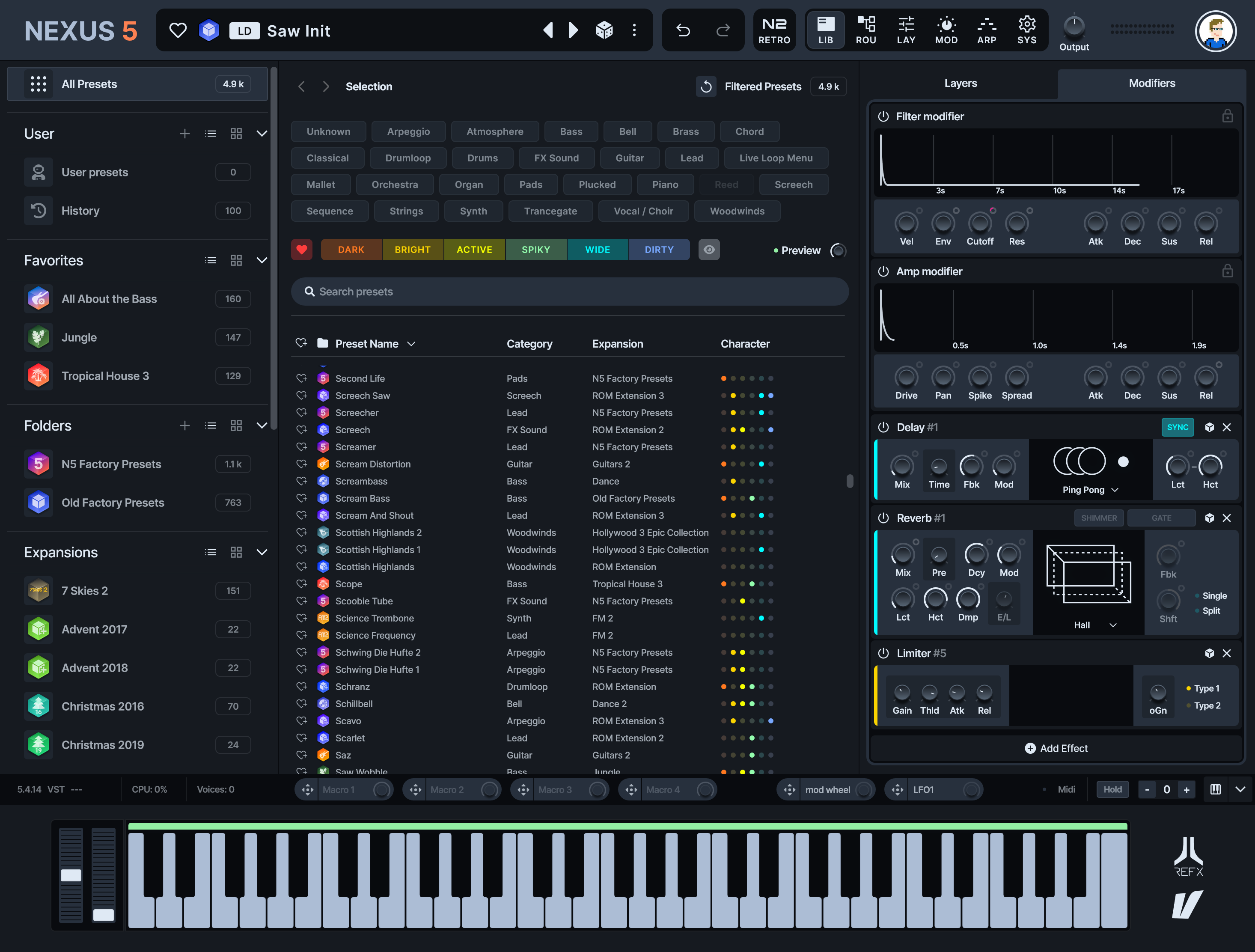
reFX Nexus 5 is the leading rompler plugin for pop and dance music producers who want studio-quality sounds without spending hours on sound design. Built around a library of meticulously produced presets covering everything from supersaw leads and punchy basses to lush cinematic pads, Nexus 5 delivers broadcast-ready sounds the moment you press a key.
Unlike synthesizers that ask you to construct every sound from raw oscillators and filters, Nexus 5 hands you the finished result and gets you straight to writing music. That philosophy makes it one of the most efficient creative tools available for producers who work in pop, EDM, trance, and commercial dance music, where speed and sonic polish matter above all.
What Is a Rompler and How Does It Differ from a Synthesizer
A rompler (read-only memory player) plays back high-quality audio samples stored inside its engine rather than generating waveforms through mathematical algorithms. Each preset in Nexus 5 is built from recordings of real instruments, analog synthesizers, and digitally produced sources, layered and processed to produce a complete sound that requires no further synthesis work on your part.
A traditional synthesizer such as Serum or Massive X starts with raw waveforms and gives you filters, envelopes, and modulators to shape them into something usable. That approach rewards producers who understand synthesis and have time to experiment. A rompler like Nexus 5 starts at the finished sound and only asks how you want to perform it, which reverses the creative workflow entirely.
Nexus 5 includes ADSR controls, a filter section, and a built-in effects chain, but deep sound design from first principles is not its purpose. The instrument is optimized for speed, consistent quality, and immediate inspiration, not for producers who want to rebuild a patch waveform by waveform.
A Categorized Preset Library Built for Commercial Music
Nexus 5 ships with thousands of presets organized into clearly labeled categories. Each category is divided further into sub-genres and styles, so finding a preset suited to a specific track takes seconds rather than a lengthy scroll through an unstructured browser.
- Leads, Pads, Keys, Bass
- Brass, Pianos, Plucks, Arpeggios
- Drums, FX, Sequences
The search function lets you filter by keyword, type, and tags. Need a bright trance supersaw or a lush pop pad for a bridge section? A keyword search returns relevant results immediately, and the preview system lets you audition each preset in key before committing to it.
Quality consistency across the library is a major practical advantage. Every preset in the Nexus 5 factory library has been produced to a standard suitable for commercial release. You are not sifting through low-quality filler to find the few usable sounds, which is a common frustration with synthesizer preset banks where quality varies widely between designers.
How Expansion Packs Work
reFX offers a large and growing catalog of expansion packs that extend the Nexus 5 library well beyond the factory content. Each expansion is produced by a dedicated sound designer or a guest artist and focuses on a specific genre or instrument category: trance arpeggios, hip-hop keys, cinematic pads, festival drops, and dozens more. The guest artist series brings sounds tied to recognizable production styles from known producers.
Expansion packs install directly into the Nexus 5 browser and appear as labeled collections alongside the factory library. No additional software to configure. Once installed, the expansion presets appear in search results and category filters together with the built-in sounds, making the entire library feel unified rather than fragmented across separate instruments.
Buying targeted expansions is an efficient way to shape your sound palette. Rather than purchasing a general-purpose instrument and hoping the presets match your genre, you can add Nexus 5 expansions built specifically for the music you produce, keeping your library focused and relevant to your actual workflow.
Nexus 5 vs. Serum and Omnisphere: Preset Quality vs. Sound Design Depth
Serum by Xfer Records is a wavetable synthesizer built for producers who want to design sounds from the ground up. It has a visual wavetable editor, a 16-slot modulation matrix, and a community-supported preset ecosystem with thousands of commercial and free banks. If crafting original timbres and understanding synthesis is central to your workflow, Serum rewards that investment in ways Nexus 5 does not. Nexus 5 does not offer the same depth of sound design, but that is a deliberate product decision, not a technical shortcoming.
Omnisphere by Spectrasonics is a hybrid synthesis instrument with a 64GB library covering orchestral, cinematic, and experimental territory. It supports multiple synthesis engines per patch and a deep modulation system, making it suitable for film composers and producers who need both breadth and synthesis flexibility. Nexus 5 sits closer to the pop and dance end of that spectrum, with a more focused library and a simpler interface optimized for speed over architecture.
Producers who benefit most from Nexus 5 are those who work fast, produce in commercial pop or dance genres, and want sounds ready to place in a mix without additional processing. It is also a strong complement for producers who already own a deep sound design synth and want a dedicated source of polished, professionally produced presets alongside it.
Frequently asked questions
Is reFX Nexus 5 suitable for producers who want to learn synthesis?
No — Nexus 5 is designed for producers who want polished presets rather than synthesis education. It has <code>ADSR</code>, filter, and effects controls, but the engine does not expose raw oscillators or a modulation matrix the way a synthesizer does. Producers who want to learn synthesis from first principles will get more out of a wavetable synth like <strong>Serum</strong> or a subtractive synth like <strong>Massive X</strong>, where every stage of the signal chain is visible and adjustable.
How many presets does Nexus 5 include and can I add more?
The Nexus 5 factory library ships with thousands of categorized presets covering leads, pads, bass, keys, arpeggios, and more. reFX also offers a large and growing catalog of genre-specific expansion packs, each adding hundreds of additional presets focused on styles such as trance, hip-hop, cinematic, and festival EDM. Expansions are purchased separately and install directly into the preset browser without any additional configuration required.
Can I use Nexus 5 for hip-hop and R&B or is it mainly for EDM?
Nexus 5 works well for hip-hop and R&B. It has dedicated preset categories and expansion packs covering hip-hop, R&B, trap, and soul-influenced sounds including lush piano textures, warm bass patches, and chord pads with a gospel character. The plugin is historically associated with EDM and trance because of reFX's roots in those genres, but the factory content and available expansions cover commercial music broadly. Many pop and hip-hop producers use Nexus 5 as a primary source for keys, melodic elements, and textural pads.
Recommended Related Products
reFX Nexus 5
Next-level production rompler with massive library of chart-ready sounds.