
Soundtheory Gullfoss: The Intelligent EQ That Listens Like a Human
Gullfoss is not a conventional EQ. It uses perceptual analysis to find what the ear wants to hear and adjusts frequency balance in real time. Learn the four controls, the best use cases, and when to reach for it instead of a manual EQ.
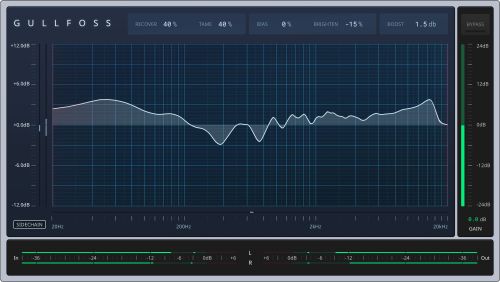
Gullfoss from Soundtheory occupies a category of its own. Unlike a conventional equalizer where you identify a problem frequency and draw a boost or cut, Gullfoss continuously analyzes the incoming audio through a model of human auditory perception and makes hundreds of micro-adjustments per second to produce a frequency balance that the ear finds natural and clear. There are no frequency bands to place, no Q values to set, and no spectrum analyzer to stare at. The plugin decides what to do based on what the sound actually is, not where a static curve points.
The practical result is a tool that resolves two of the most common problems in dense mixes: masking and uneven spectral density. Masking occurs when one element in a mix hides another at overlapping frequencies, making the mix sound congested even when every track sounds good in isolation. Gullfoss detects this masking in real time and reduces it by gently pulling back whatever is dominating a shared frequency region, allowing the hidden material to come forward without surgical notch cutting or volume automation.
How Perceptual Analysis Shapes the Sound
Soundtheory built Gullfoss around a computational model of auditory perception rather than a traditional filter bank. The algorithm does not look for resonances at fixed frequencies. Instead it models how the human auditory system groups and separates sounds, identifies which parts of the spectrum are being heard clearly and which are being masked or overwhelmed, and calculates frequency-specific gain adjustments that push the balance toward what the ear finds most intelligible.
This approach means Gullfoss responds differently on every source material. Applied to a dense orchestral mix it may smooth mid-range pile-up from multiple instruments sharing the same harmonic space. Applied to a single vocal it may open up the presence region that a natural room reflection has blurred. The output is always tied to the perceptual content of the input rather than to a fixed target curve or genre preset, which is why the plugin works across acoustic music, electronic production, and broadcast material without requiring separate settings for each.
The processing is also fully dynamic. Gullfoss does not apply a static correction curve that stays the same throughout a track. It re-evaluates the incoming audio continuously and updates the gain adjustments as the content evolves, so a section that shifts from sparse to dense receives more active correction than a consistent pad or drone. This real-time adaptation is what separates it from static tonal balance tools and single-band dynamic EQs.
The Four Controls
Recover sets how aggressively the plugin boosts frequency regions that are being masked or underrepresented in the mix. A higher Recover value pulls quieter spectral content further forward, adding clarity, detail, and perceived openness. On a dense mix bus, values between 20 and 40 percent often produce an audible improvement in separation without sounding processed. On a vocal that needs more presence without EQ brittleness, Recover above 50 percent can deliver that quality in a single adjustment.
Tame controls the opposite action: how much Gullfoss attenuates frequency regions that are too dominant or are masking other elements. High Tame values reduce harshness, tame resonant buildup, and smooth frequency spikes that a static EQ cut would only partially address because the spike moves with the performance. Bias shifts the overall balance of the perceptual analysis toward lower or higher frequencies, effectively telling the algorithm which part of the spectrum to pay more attention to. A negative Bias value focuses Gullfoss on the low end, which is useful for controlling a thick, uneven bass register on the mix bus or master. A positive Bias focuses activity on the upper midrange and high frequencies, where vocal clarity and string air tend to compete.
Brighten adds or removes high-frequency gain in a way that complements the perceptual processing rather than applying a flat shelf. It does not apply a fixed dB boost above a crossover point. It interacts with the analysis to add presence in a way that avoids the brittle, artificial quality that a static high-shelf often produces on material that already has peaked high-frequency content. Most producers use small Brighten amounts between 5 and 20 percent to restore air that gets compressed away by a bus compressor or limiter.
Recover 25–35%, Tame 10–20%, Bias near zero. Adjust from there by ear — small moves are often enough.Where to Use Gullfoss in a Session
A common starting point on the mix bus is Recover between 25 and 35 percent, Tame between 10 and 20 percent, and Bias at or near zero. This is especially valuable when the mix comes from another engineer and individual stems are not available for rework.
Gullfoss works well as a send effect on parallel channels, particularly for drums and bass. Blending a processed parallel signal at 30 to 50 percent alongside the dry signal allows producers to capture the clarity benefit while preserving the punch and weight of the original — an approach that avoids the slight gain reduction side effect that high Tame values can introduce on the direct signal.
- Mix bus — before or after a bus compressor; brings forward detail masked when many tracks play simultaneously.
- Mastering chain — between a gentle EQ stage and the final limiter; adapts dynamically to section-to-section spectral variation.
- Vocal chain — after compression; adds presence and openness, often replacing a broad upper-midrange boost on the channel EQ.
- Drum bus — Tame 30–40% smooths inconsistent snare ring and cymbal harshness across takes without touching transient character.
- Parallel send — blend at 30–50% with the dry signal to capture clarity while preserving punch and weight.
Gullfoss vs Manual EQ, and the Kraftur Companion
Gullfoss is not a replacement for a manual EQ. If a track has a specific resonant peak at 3.4 kHz that sounds harsh in every section of a recording, a notch filter on a conventional EQ handles it faster and with less processing overhead. If a kick drum needs its low end shaped before it hits a compressor, a static low-shelf or high-pass combination on a traditional EQ is the right choice. Gullfoss excels at problems that are dynamic, spectral, and perceptual: congestion that changes with the arrangement, masking that moves around as different instruments enter and exit, and the general flatness that dense mixes develop when many tracks compete for the same ear.
The two tools work well in combination, with manual EQ handling structural problems on individual tracks and Gullfoss addressing the emergent behavior of the full mix.
Soundtheory also makes Kraftur, a dynamic saturation plugin that shares the perceptual analysis foundation of Gullfoss. Where Gullfoss works through frequency balance, Kraftur adds harmonic content in a perceptually aware way, emphasizing the harmonics the ear expects to hear from the source material rather than applying a fixed saturation character. Producers who use Gullfoss on the mix bus often find that adding a light Kraftur instance on the same bus complements the clarity work with warmth and presence, a one-two approach to the tonal and harmonic dimensions of a mix simultaneously.
Frequently asked questions
Is Gullfoss a dynamic EQ or something different?
Gullfoss uses perceptual analysis, not traditional band-based dynamic EQ. A dynamic EQ compresses or expands a fixed frequency band when the signal at that band crosses a threshold. Gullfoss instead models human auditory perception continuously and applies gain adjustments across the full spectrum wherever the balance departs from what the ear finds natural. The result is a more fluid, context-sensitive correction that responds to the relationship between sounds rather than the absolute level at any single frequency.
Where in the signal chain does Gullfoss work best?
Gullfoss is most effective on the mix bus, master bus, and individual stems such as drums or vocals. On the mix bus it addresses masking between simultaneous elements. On the master bus it handles section-to-section spectral variation. On individual stems it adds clarity and reduces harshness dynamically. It can run on single instruments but its perceptual analysis is designed to shine when the incoming material has multiple competing elements, so it delivers its most distinctive results on buses and full mixes.
What does Kraftur add on top of Gullfoss?
Kraftur is a dynamic saturation plugin from Soundtheory that uses the same perceptual analysis framework as Gullfoss but focuses on harmonic content rather than frequency balance. While Gullfoss clears congestion and improves spectral separation, Kraftur adds warmth, density, and the harmonic richness that gives a mix presence and energy. The two plugins address different dimensions of the same problem and pair naturally on a mix bus, with Gullfoss handling clarity and Kraftur handling character.