
Audio Modeling SWAM All-In Bundle: Physical Modeling Solo Instruments That Actually Feel Alive
The SWAM All-In Bundle from Audio Modeling covers solo strings, woodwinds, and brass using Synchronous Waves Acoustic Modeling, a physical modeling engine that simulates how air, bow, and breath interact with an instrument in real time. Here is why that changes everything for composers who need convincing solo lines.
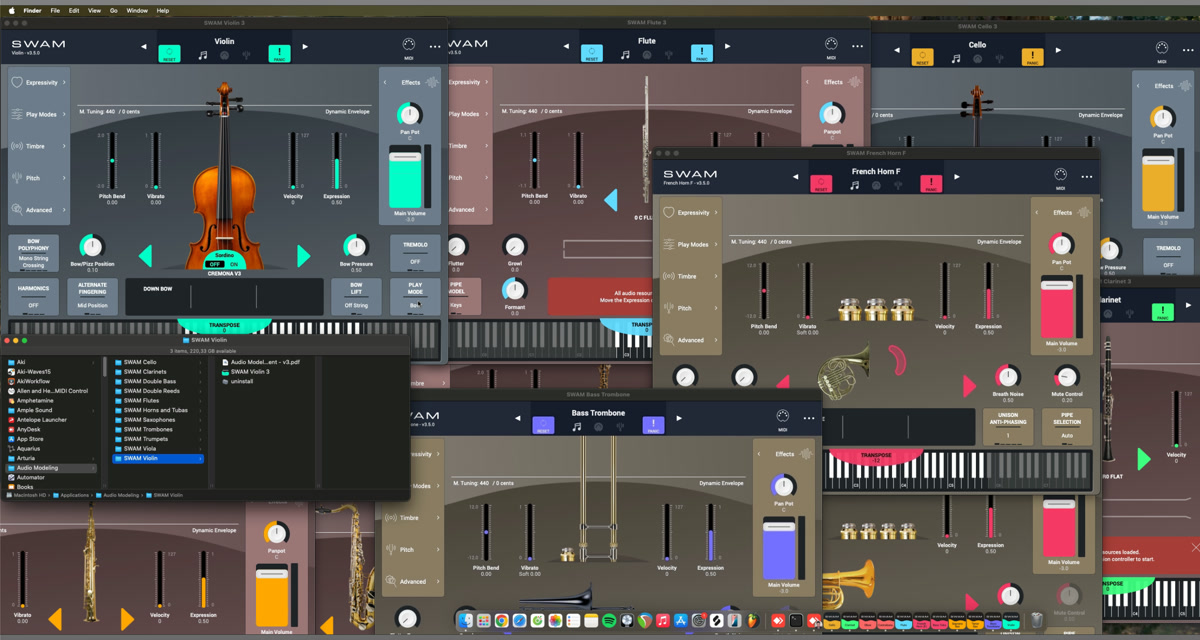
Audio Modeling SWAM instruments are built on an entirely different foundation than conventional sample libraries. Instead of recording hundreds of notes and articulations into multisampled patches, SWAM uses Synchronous Waves Acoustic Modeling to mathematically simulate the physical mechanics of sound production: a bow moving across a string, a column of air vibrating inside a clarinet bore, a brass player's embouchure shaping the resonance of a horn bell. The result is an instrument that generates its sound continuously and dynamically, the same way an acoustic instrument does, rather than playing back a pre-recorded clip that was true only under the exact conditions of that one recording session.
The All-In Bundle brings together the full SWAM catalog across three families:
- Solo strings: violin, viola, cello, double bass
- Solo woodwinds: flute, oboe, clarinet, bassoon, alto saxophone, tenor saxophone
- Brass: trumpet, horn, trombone, tuba
Why Physical Modeling Outperforms Samples for Solo Lines
Sample libraries are inherently discrete: they capture the instrument at specific pitches, velocities, and articulation states, then interpolate between those snapshots during playback. That interpolation always leaves traces. Legato transitions have a characteristic crossfade texture. Long sustains loop at some point. Vibrato is either baked into the sample or grafted on as a pitch modulation layer that does not quite track the way a real player's vibrato shifts in width and speed mid-phrase. For ensemble textures, these traces can disappear into the collective blend. For an exposed solo line, they surface immediately and break the illusion.
SWAM instruments have no loops and no crossfade stitching because the sound is never a recording to begin with. Dynamics evolve in a continuous curve across the full range of a phrase. Vibrato is a product of the physical model itself, shifting in rate and depth in direct response to your controller input. You can hold a note for thirty seconds and the tone will shift, breathe, and drift exactly as a real player would, because the engine is running the acoustic physics at every moment. This is what makes SWAM the reliable choice for solo melodic lines in film cues, where a close-mixed solo instrument sits under a magnifying glass.
MPE Controllers, Breath Controllers, and Expressive Performance
SWAM instruments are designed with expressive hardware input as a first-class concern. Breath controllers such as the Yamaha BC3 or the Aerophone series send continuous breath pressure data that maps directly to the physical models: on a flute or oboe, breath pressure is the primary driver of volume and tone character, so a breath controller gives you the same kind of dynamic shaping a real woodwind player has. The response curve is not a simple volume ramp but a full modulation of the model's air column, producing the harmonic overtone shifts and tonal darkening that define real woodwind dynamics.
MPE (MIDI Polyphonic Expression) controllers, including the Roli Seaboard, Osmose, LinnStrument, and compatible hardware, take this further by sending per-note pitch, pressure, and slide data simultaneously. On a SWAM violin you can play a phrase where each note has its own independent vibrato width, bow pressure feel, and portamento slope controlled by finger position on a Seaboard surface. For live performers, this creates a genuinely playable acoustic instrument in software, one that responds to the nuance of physical gesture rather than a grid of fixed velocity steps.
Who SWAM Is Built For and How It Fits a Composer's Toolkit
SWAM instruments fill a specific gap that ensemble string, woodwind, and brass libraries cannot address: the convincing exposed solo line. When a cue calls for a solo violin melody over a sparse accompaniment, a solo oboe doubling a vocal line, or a solo trombone delivering a statement in a jazz-influenced score, sample libraries typically reveal their limitations. The loop texture, the fixed articulation vocabulary, and the absence of real physical response all become audible. SWAM removes those limitations and hands the expressive control back to the performer at the keyboard.
For composers who eventually work with live players, SWAM also functions as an accurate reference tool. Because the instruments behave according to real physical constraints, a line that works on a SWAM violin is generally a line that a real violinist can execute. Range limits, register transitions, and breath capacity constraints are all modeled faithfully. Sketching a woodwind soli passage on SWAM instruments will expose fingering awkwardness or breathing impossibilities far earlier than a conventional sample library, where you can write anything and it simply plays back without protest. The All-In Bundle makes this reference available across the complete solo orchestral palette in a single package.
Frequently asked questions
Do SWAM instruments require a specific DAW or plugin format?
SWAM instruments run in any DAW that supports <code>VST3</code>, <code>AU</code>, or <code>AAX</code> — no Kontakt or third-party sampler license required. Each instrument installs as a standalone plugin with no additional host dependency.
Can SWAM instruments sound realistic without a breath controller or MPE hardware?
Yes — many composers use them effectively with a standard MIDI keyboard, mod wheel, and velocity sensitivity. Aftertouch adds another layer of expression if your keyboard supports it. That said, the instruments respond most naturally to continuous physical input, so a breath controller for woodwinds or a pressure-sensitive surface for strings will bring the models significantly closer to a real performance feel. Starting with a standard keyboard is a reasonable entry point before investing in specialized hardware.
How does the All-In Bundle compare to buying individual SWAM instruments?
The All-In Bundle includes every SWAM solo instrument across strings, woodwinds, and brass at a substantially lower combined price than purchasing each instrument separately. If you work across multiple orchestral families and need solo coverage throughout, the bundle is the most cost-effective path. If you only need one or two specific instruments, individual licenses are also available.
Recommended Related Products
SWAM All-In Bundle
Physically modelled solo instruments with unmatched expressive control.