
SWAM Physical Modeling: Getting Expressive, Realistic Solo Instruments
Why SWAM modeled instruments sound alive, and how to use breath, expression, and continuous control to play believable solo strings, winds, and brass.
Most orchestral libraries are built from recorded samples: a player performs every note and articulation, and the software plays those recordings back. SWAM by Audio Modeling works completely differently. SWAM stands for Synchronous Wave Acoustic Modeling, a physical modeling technology that generates the instrument's sound in real time instead of replaying recordings. That single difference is why SWAM solo instruments can be so much more expressive than sample libraries.
The SWAM All In bundle covers physically modeled solo strings, hybrid-modeled solo woodwinds, and modeled solo brass: violin, viola, cello and double bass; clarinets, double reeds, flutes and saxophones; and trumpets, trombones, horns and tubas. This guide explains why they feel alive and how to play them convincingly.
Modeling vs Sampling: Why It Matters
A sampled instrument is a snapshot. To capture more expression, developers record many velocity layers and articulations, but you are still triggering fixed recordings and switching between them. There is always a ceiling on how smoothly you can move between dynamics or shape a single sustained note, because no recording exists for the exact in-between you want.
SWAM instruments are not pre-recorded articulations. They are complex models that shape almost any articulation and phrasing in real time. Because the sound is generated as you play, you can morph continuously from the softest pianissimo to a full fortissimo within one held note, bend pitch, change vibrato, and crossfade timbre, all smoothly, with no crossfading between separate samples. That is what gives SWAM its signature lifelike realism on exposed solo lines.
Expression Is Performed, Not Programmed
The realism does not come from picking the right preset. It comes from how you control the instrument while it sounds. Dynamics, vibrato, bow pressure or breath, and timbre are all live, continuous parameters you shape as you play.
A SWAM line played with static, flat MIDI dynamics will sound lifeless, while the same notes shaped with continuous expression will sound like a real player. The instrument rewards performance: the more musically you move the controls, the more convincing it becomes.
- Dynamics and expression are continuous, not stepped velocity layers
- A single sustained note can swell, fade, and change colour with no sample crossfade
- Vibrato, pitch, and timbre respond live as you perform
Controllers: Breath, Wind, and Expression Pedals
You can play SWAM instruments with any MIDI device, but they truly come alive with continuous controllers. For woodwinds and brass, a breath controller or a wind controller (like an EWI or a MIDI wind instrument) is transformative, because breath pressure maps directly to the instrument's dynamics and articulation, exactly as a real wind player would blow. The result is phrasing no keyboard performance can easily match.
If you play from a keyboard, assign continuous control to an expression pedal, a modulation wheel, or a fader, and use it to drive dynamics in real time while your hands play the notes. For strings, map bow pressure and bow position to controllers to shape attack and tone. The principle is the same across the bundle: route a physical, continuous controller to the expression and dynamics parameters so you are performing the swell, not drawing it in afterwards.
Practical Tips for Believable Performances
Two habits separate convincing SWAM performances from robotic ones.
- Record your expression control as a continuous take rather than drawing in straight automation lines. Real instruments are never perfectly steady, and small natural fluctuations in dynamics are a big part of why an acoustic instrument sounds human. Let your physical controller capture those imperfections.
- Pay attention to note transitions and legato. Overlapping notes produce realistic legato and portamento, so play phrases the way a real musician would breathe and bow them. Add vibrato that starts after the note attacks rather than instantly, and the solo will sit convincingly inside a sampled orchestral arrangement or stand completely exposed on its own.
Frequently asked questions
What does SWAM stand for and how is it different from a sample library?
SWAM stands for Synchronous Wave Acoustic Modeling. Unlike sample libraries, which play back pre-recorded notes and articulations, SWAM generates the instrument's sound in real time using physical modeling. This lets you continuously shape dynamics, vibrato, pitch, and timbre within a single note, which sampled instruments cannot do as smoothly because they rely on switching and crossfading fixed recordings.
Do I need a breath controller to use SWAM instruments?
No, any MIDI keyboard works, but a breath or wind controller dramatically improves realism for woodwinds and brass because breath pressure maps directly to dynamics and articulation. From a keyboard, assign a continuous controller such as an expression pedal or mod wheel to drive dynamics in real time, which gets you most of the way to a believable, performed sound.
Why does my SWAM instrument sound robotic?
Static expression and dynamics are almost always the cause. SWAM is designed to be performed with continuous control over dynamics, vibrato, and timbre while the note sounds. If you enter flat MIDI with constant velocity and no expression automation, the model has nothing to respond to. Record continuous expression with a controller and the same notes will sound alive.
What instruments are included in the SWAM All In bundle?
The All In bundle covers solo strings (violin, viola, cello, double bass), solo woodwinds (clarinets, double reeds, flutes, saxophones), and solo brass (trumpets, trombones, horns, tubas). The strings are physically modeled, the woodwinds are hybrid modeled, and the brass are modeled, all designed for expressive, real-time solo performance.
Recommended Related Products
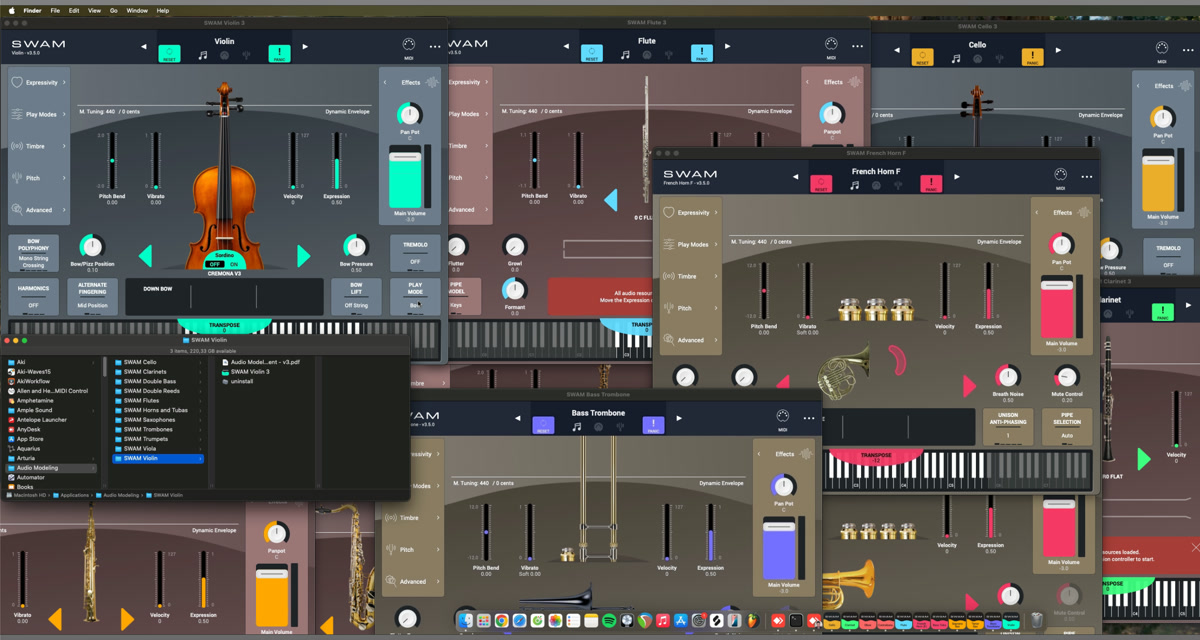
SWAM All-In Bundle
Physically modelled solo instruments with unmatched expressive control.