
Valhalla DSP Bundle: The Reverb Plugins That Define Modern Music Production
Valhalla DSP built its reputation on exceptional sound quality at an accessible price. This guide covers VintageVerb, Room, Delay, and Shimmer and how to use each one effectively.
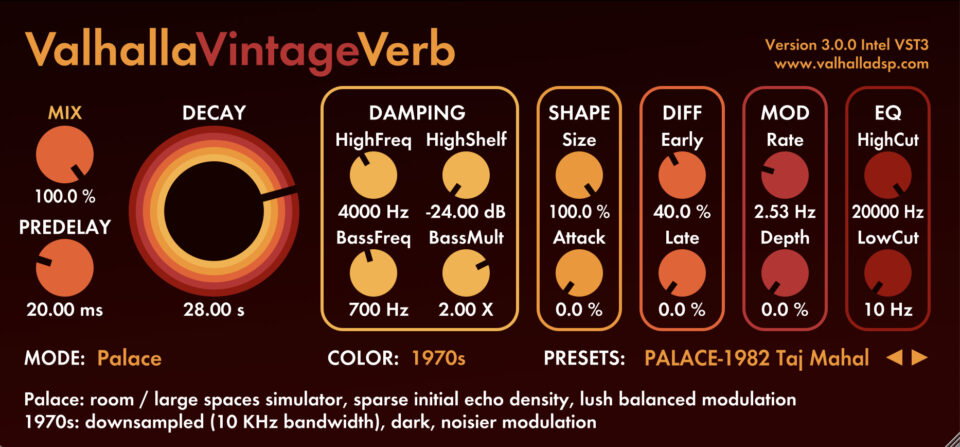
Valhalla DSP changed the reverb plugin market in 2010 when developer Sean Costello released VintageVerb at $50, a price that undercut professional hardware and competing software by hundreds of dollars while matching their sound quality in blind tests conducted by the mixing community.
The company operates as a focused one-person developer studio, which means every algorithm receives long-term attention and iterative refinement through free updates. Producers who bought VintageVerb in 2010 continue to receive improvements today at no additional cost.
The full bundle covers every reverb and delay scenario a producer encounters: lush concert halls, tight live rooms, pitch-shifted shimmer textures, and tempo-synced delay with built-in diffusion. Each plugin is priced between $50 and $65, making the entire suite accessible on a home studio budget.
VintageVerb: the flagship plugin
VintageVerb models the character of digital reverb hardware from three distinct eras. The 1970s color sounds warm and slightly lo-fi, reminiscent of early plate and chamber hardware. The 1980s color is bright and dense, capturing the large-hall reverb sound prominent in that decade's pop and rock records. The NOW color blends both qualities for a modern, neutral reverb character suited to contemporary mixing.
Hall mode at decay times above four seconds is the standard choice for orchestral strings and cinematic scoring. Plate mode with a pre-delay of 15 to 25ms sits naturally on lead vocals, snares, and piano in pop, R&B, and soul sessions.
VintageVerb has become a standard tool in professional and home studio environments because a single instance handles both short ambience duties and long atmospheric tails. Its CPU footprint is low enough to run multiple instances simultaneously on a modern machine, which makes it practical on large sessions where reverb sends would otherwise accumulate overhead.
- Hall — long, dense tail; ideal for orchestral strings and cinematic scoring
- Plate — smooth, classic tail; fits lead vocals, snares, and piano
- Room — tight, natural ambience; works on drums and acoustic instruments
- Chamber — vintage character with focused density
- Bright Room, Sanctuary, Chameleon, Chorus — specialized textures for sound design and atmospheric work
ValhallaRoom and ValhallaDelay
ValhallaRoom is a dense, short-to-medium algorithmic reverb designed for instruments that need spatial presence without excessive wash. Its Early Reflections section controls the sense of physical space before the reverb tail develops, giving producers precise control over perceived room size independent of the decay time setting.
The plugin excels on drums, electric guitars, and keyboards where longer reverb modes would obscure transients. Keeping the SIZE parameter between 20 and 40 percent produces a tight, natural-sounding room without smearing the attack. Many producers route the entire drum bus through a single ValhallaRoom instance to glue the kit into a believable acoustic environment.
ValhallaDelay provides eight distinct algorithms including tape, multi-tap, pitch-shifted, and diffusion delay. The DIFFUSION knob blurs the repeats into a reverb-like texture, making it a hybrid tool for ambient, post-rock, and electronic production. Syncing delay time to the project BPM and adding moderate diffusion creates pulsing, rhythmic pads without introducing additional harmonic content to the mix.
ValhallaShimmer: pitch-shifted reverb for atmospheric production
ValhallaShimmer layers pitch-shifted feedback into the reverb signal, creating the ethereal, swelling textures heard across ambient, post-rock, cinematic, and neo-soul productions. The SHIFT parameter controls the pitch interval of the feedback, with the most common settings being plus one octave for bright shimmer and minus one octave for a deep, sub-heavy wash that adds weight to pad sounds.
Setting SHIFT to plus one octave with FEEDBACK above 70 percent creates an infinite-sustain texture that works as a background layer under sparse piano or guitar. Adding a second pitch layer at a perfect fifth interval produces lush, harmonic shimmer without becoming melodically distracting in a dense mix.
In hip-hop and trap, a subtle Shimmer instance on string samples adds supernatural weight without creating an obvious reverb tail that competes with the vocal. Electronic producers use it on synth leads and vocal chops to build tension through ambience rather than arrangement.
Frequently asked questions
Which Valhalla plugin should I start with?
VintageVerb is the best starting point. It covers the widest range of use cases, from tight room ambience to long concert hall tails, and its three color modes give you a clear, hands-on way to understand how reverb character changes with era modeling. Most producers find it handles 80 percent of their reverb needs within a single interface.
Are Valhalla plugins CPU-intensive?
Valhalla plugins are highly efficient relative to their sound quality. Running five to ten instances simultaneously on a modern processor is routine. The algorithms are well-optimized and perform consistently even on older hardware, which is one reason they remain popular in professional studios where session track counts are high.
Can I use Valhalla plugins on both Mac and Windows?
All Valhalla plugins are available as VST, VST3, AU, and AAX formats for both Mac and Windows. A single license covers both platforms, so switching DAWs or moving between studio machines does not require additional purchases.
Recommended Related Products
Valhalla DSP Bundle
World-class reverb and delay plugins - VintageVerb, Room, Delay, Supermassive and more.