
Serum Beginner Guide: Design Your First Wavetable Synth Patch from Scratch
Learn how Serum's wavetable engine, oscillator stack, and mod matrix work together so you can build any lead or bass patch from a blank slate.
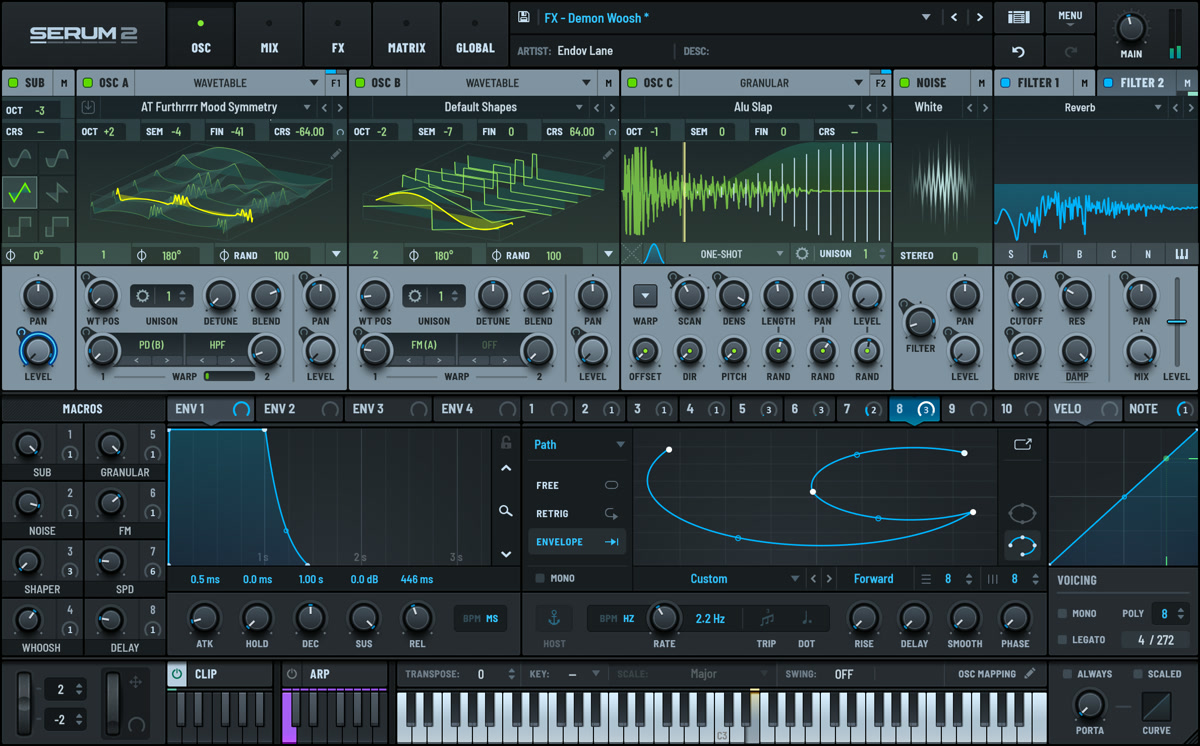
Serum by Xfer Records is the most widely used software synthesizer in modern music production. Built around a powerful wavetable engine, it combines visual clarity with deep sound design capability, giving producers immediate feedback on every edit they make. Whether you produce EDM, trap, pop, or lo-fi, understanding Serum's architecture will accelerate your workflow across every genre.
What Is Wavetable Synthesis
A wavetable is a stored collection of single-cycle waveforms. The oscillator reads through these waveforms and can morph between them in real time, creating movement and texture that static waveforms cannot produce. Serum ships with hundreds of factory wavetables and lets you draw, import, or extract your own from any audio file.
The key advantage of wavetable synthesis is visual feedback. Serum displays the waveform directly in the oscillator window, so you can see exactly what shape you are generating and watch it animate as modulation moves the wavetable position. Morphing that shape over time using an LFO or envelope is what gives wavetable sounds their characteristic shimmer.
Unlike FM or subtractive synthesis, wavetable synthesis lets you start from a precisely defined harmonic snapshot and add motion to it. This makes complex, evolving textures much faster to design and much easier to control than with traditional methods.
Signal Flow: Oscillators, Sub, Noise, and FX
Serum has two main wavetable oscillators (OSC A and OSC B), a sub oscillator, and a noise generator. OSC A and OSC B each have independent wavetable selection, unison controls, and a warp mode that reshapes the waveform using methods such as sync, bend, mirror, and formant. Combining OSC A for the primary character and OSC B for harmonic layering is the fastest route to a full, professional sound.
The sub oscillator outputs a pure sine, triangle, or pulse wave at a fixed octave below OSC A. Adding a sub is the fastest way to give a thin patch weight without cluttering the mid-range, which is why virtually every Serum bass patch uses it. The noise generator adds filtered bursts of noise that work well for percussion layers, breath textures, or rhythmic noise sweeps.
After the oscillators, signal passes through two multimode filters (each with dozens of filter types), then through an effects chain with ten processors including distortion, EQ, compressor, reverb, and delay. The order of the FX modules is fully drag-and-drop, giving Serum more internal routing flexibility than most hardware synths at any price point.
Building a Lead or Bass from Scratch
- Choose a harmonically rich wavetable in OSC A —
Analog_BD_Sinfor bass or aSawvariant for lead. Set voices to1and the octave to your target range. - For a bass patch: engage the sub oscillator at ~50% mix and add a
LPF 24filter. Assign ENV 2 to filter cutoff with moderate attack and short decay for a punchy, envelope-driven character. - For a lead patch: add light unison (2–4 voices, low detune) to OSC A and blend a complementary wavetable on OSC B at a lower mix. Route an LFO to
wavetable positionon OSC A for movement. Finish with light reverb and a short tempo-synced delay in the FX chain.
Why Serum Dominates EDM, Trap, and Pop Production
Serum became the default synth for EDM, trap, and pop producers for three reasons: the interface is immediately legible, the preset library covers virtually every contemporary sound category, and the wavetable import system lets you use recorded samples or custom drawn shapes as oscillator sources. No other synth in this price range delivers the same combination of depth and accessibility.
The mod matrix supports 16 simultaneous modulation slots and allows any source to target nearly any destination, including per-voice randomization via the chaos sources. This depth is displayed visually on every knob that has an active modulation assignment, which means complex patches remain easy to audit and tweak at a glance.
Producers who move from using presets to designing original sounds tend to do so inside Serum first, precisely because the feedback loop is immediate and entirely visual. Once you understand Serum's architecture, the same principles transfer directly to Vital, Massive X, and any other wavetable synth you encounter in a professional session.
Frequently asked questions
What makes Serum different from Vital, which is also free?
Serum's wavetable editor is more refined and its filter selection is larger, with specialized analog-modeled filter types that Vital does not include. The main practical difference for most producers is the preset ecosystem: thousands of free and commercial preset banks are built for Serum specifically, so finding sounds and studying how they were built is significantly easier than with any alternative.
Can I use my own audio as a wavetable in Serum?
Yes — drag any audio file onto an oscillator window and Serum will analyze it and extract single-cycle frames into a fully playable wavetable with adjustable frame count and analysis mode. This is especially useful for importing analog-recorded waveforms, vocal chops, or any non-standard source you want to use as an oscillator.
How do I stop Serum patches from sounding muddy in a mix?
Reduce the unison voice count and detune amount first. Heavy unison creates a wide stereo spread but also fills the frequency spectrum densely, which clashes with other elements in the arrangement. Use the <strong>EQ</strong> module inside Serum's FX chain to cut below <code>80 Hz</code> on lead patches and above <code>3 kHz</code> on bass patches before the signal leaves the synth, keeping each layer in its own frequency lane.
Recommended Related Products
Xfer Records Serum
Visual wavetable synthesizer with high-quality sound and flexible routing.